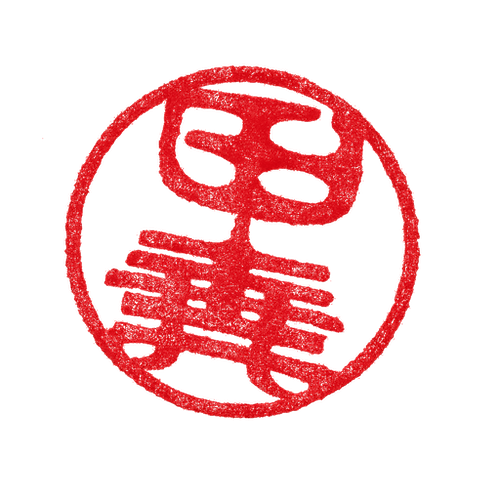
Ryukyu Karate Jutsu - Shuhaku-den
琉球空手術 首泊伝
Shuhaku-den is the name given to the karate I practise and teach today. It represents a continuation and development of what has been passed on to me, rather than the creation of a new style.
Where it comes from
My karate has been shaped by several traditions over more than fifty years of training. An important foundation is Shinjin-Ryu Okinawa-Te, founded by Katsumi Tamaki sensei in Japan in 1979.
I first began studying under Tamaki sensei in the early 1980s. Although my subsequent training took me in different directions, his teaching remained an important influence on my understanding of karate.
My experience of Wadō-ryū, Sankukai, Shitō-ryū and other approaches has also contributed to what I practise today. Each has provided opportunities to learn, compare and reconsider my understanding.
Understanding the name
The name Ryukyu Karate Jutsu - Shuhaku-den reflects both the origins of my karate and the nature of its continued transmission.
Ryukyu acknowledges the Okinawan roots of karate. Karate means empty hand, while Jutsu refers to an art or method, reflecting the practical emphasis of my training.
The name Shuhaku-den was offered by Tamaki sensei. Its intended meaning acknowledges the influences of Shuri-te, Naha-te and Hakutsuru, or White Crane, within the karate transmitted to us. The term den refers to transmission — the passing on of knowledge.
The name is an acknowledgement of those influences and the relationship from which Shuhaku-den developed, rather than a claim to a separate ancient lineage.
Permission to develop
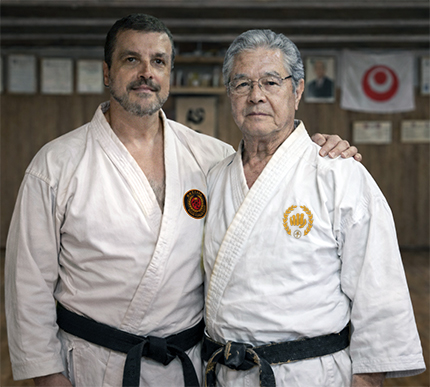
As my understanding of karate developed, my teaching increasingly reflected my own experiences, particularly in relation to civilian self-protection.
Tamaki sensei granted me permission to pursue my own direction beyond the established curriculum and regulations of Shinjin-Ryu Okinawa-Te. In doing so, he offered the name Shuhaku-den.
This was a recognition that my karate had developed in its own direction, while maintaining its connection to what he had transmitted to me.
On 14 May 2024, I was awarded Menkyo Kaiden by Tamaki sensei in Shinjin-Ryu Okinawa-Te. Menkyo Kaiden is traditionally understood as a licence of full transmission. I regard this not as the completion of my learning, but as a responsibility to continue studying, developing and passing on what I have received.
Rhys Collins Hanshi, 9th Dan, has also been an important influence and continues to provide advice and support in the development of my karate.
I value these relationships, not simply for the recognition they have given me, but for the opportunity to continue learning and developing my understanding.
Continuity rather than separation
I do not consider Shuhaku-den to be another style of karate in the conventional sense. Much of what I practise remains recognisable within the traditions I have studied.
I have retained traditional kata, fundamental movements, paired practice, grades and many of the customs associated with karate training. What has developed is my understanding of their purpose and how I teach them.
Shuhaku-den provides a way of acknowledging that development without losing sight of where my karate came from.
Respecting what has been passed on to me does not remove my responsibility to understand it.
Applied Methods
Applied Methods is the term I use to describe how I approach the study and practice of my karate.
It is not another style or system. It reflects an approach grounded in experience, context, practical application and a willingness to question and test what is being taught.
It is also the name under which I have published much of my writing about karate, its practice and the responsibilities that accompany teaching it.
Ryukyu Karate Jutsu - Shuhaku-den identifies the karate I practise and transmit. Applied Methods describes how I approach that work.
A continuing responsibility
Being given the freedom to develop my karate carries a responsibility. I want to preserve what remains valuable, reconsider what I no longer understand in the same way, and pass on something that is useful to those who train with me.
My intention is not to establish another tradition that students must follow without question, but to give them the knowledge and understanding to continue their own development.
Shuhaku-den is part of that continuing process.